B · Barriers
Protect the asset itself.
Consider the enclosure, room and surrounding fabric together. Define the protection each boundary must provide for the asset and the assessed threat.


Methodology
Published NPSA guidance informs the protective framework. Palisade applies it to your assets, credible threats and operational requirements.
Palisade / Winchester · UK wide
Protecting Your Assets
Consider physical, personnel and cyber dependencies together. The five functions below are supported by security planning.
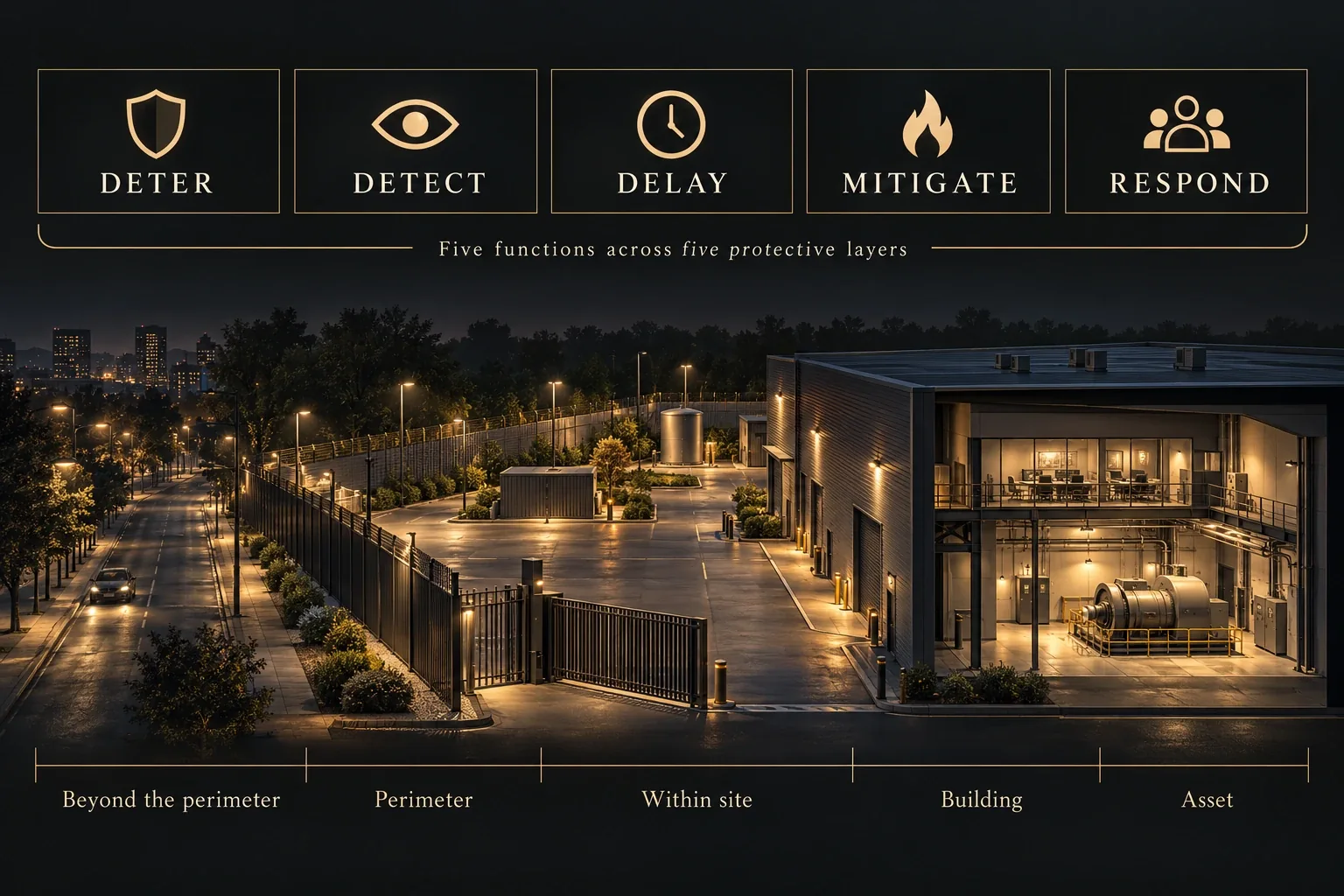
Discourage hostile action.
Recognise and verify a threat; initiate action.
Create time for protective intervention.
Reduce consequences for people and operations.
Prevent the adversary achieving their objective.
Across the protective layers
These are assessment areas, not mandatory nested barriers. Exposure and essential dependencies can sit outside the main site.
The descriptions are Palisade’s interpretation of the published framework.
Generic illustration of connected protective layers.
Public information, external approaches, off-site assets and essential dependencies.
Boundaries and access points; detection, delay and response working together.
Internal movement, restricted areas and situational awareness.
Entry, zoning and sensitive functions or information.
Protection of the critical asset itself, including isolated assets.
Critical asset protection · STaMP
Covert compromise requires an asset-centred approach. NPSA’s published Surreptitious Threat Mitigation Process (STaMP) principles complement the five protective functions: effective Barriers, controlled Access and Detection — BAD.
Place these measures as close to the critical asset as possible, then consider the surrounding room, building and site. For surreptitious threats such as espionage, the emphasis is on detecting compromise; delay alone does not establish protection.

B · Barriers
Consider the enclosure, room and surrounding fabric together. Define the protection each boundary must provide for the asset and the assessed threat.
A · Access control
Align permissions, entry controls and working procedures with legitimate need. Include staff, visitors and contractors, and review access when roles change.
D · Detection
Consider how unauthorised access or interference would be identified and assessed. Connect indications to clear responsibilities and an appropriate response.
Palisade starts with the asset’s value and the consequences of compromise, assesses relevant threats and vulnerabilities, and defines the required protective outcomes. Barriers, access control and detection are considered together across the layers, including insider risk and physical, personnel and cyber dependencies. Written operational requirements guide improvements; proportionate testing, response exercises and review provide evidence that the arrangements work.
These application steps describe Palisade’s approach in accordance with NPSA STaMP guidance. This section summarises only publicly available principles, details of the full methodology are held restricted until consultation.
NPSA: asset-centred BAD and STaMP principles · NPSA: physical and technical measures for insider risk
Use of published guidance does not imply NPSA accreditation or endorsement.
Agree important assets, consequences and threats relevant to the organisation. Separate evidence from assumptions so protective requirements and recommendations have a clear basis.

Review vulnerabilities and how controls work with procedures, responsibilities and essential dependencies. Consider how the site actually functions; assurance should answer defined questions about those connections.

Set the required protective outcome and prioritise recommendations.

Exercise or test where evidence is needed; follow through on remediation.

NPSA: Protecting Your Assets · NPSA: Operational Requirements
Use of published guidance does not imply NPSA accreditation or endorsement.